National Pension System: Not just a tax-saving tool — new rules, retirement benefits & more explained


For millions of salaried professionals and self-employed Indians, financial concern is not just job loss or market volatility — it is securing a safety net in retirement.Unlike most government employees who are covered under pension schemes, most private sector workers today must build their own retirement fund.
This has made the National Pension System (NPS), regulated by the Pension Fund Regulatory and Development Authority, one of the more sought-after financial tools for long-term security.Introduced as a structured pension savings scheme, the NPS has grown into a widely used retirement platform for government employees, corporate workers, professionals and self-employed individuals.
For years, the NPS was the default retirement savings framework for central government employees who joined service on or after January 1, 2004, replacing the old defined benefit pension system.
Under NPS, retirement income depends on accumulated contributions and market-linked returns, without any guaranteed minimum pension.However, the government has now introduced the Unified Pension Scheme as an alternative, offering assured payouts and greater income certainty after retirement.
With both options now available, employees must weigh the flexibility and return potential of NPS against the guaranteed pension benefits offered under UPS.
However, this option is not available to private sector employees, and hence NPS assumes significance for them.A series of NPS reforms introduced last year have made it more flexible, allowing greater withdrawals, extended investment horizons, and more investment choice.The changes signal a broader transformation; NPS is no longer just a tax-saving instrument, but a comprehensive retirement planning framework.So, let’s dive deeper into what NPS is and how it’s more than just a “tax deduction” in income tax returns.
What is NPS and why it matters
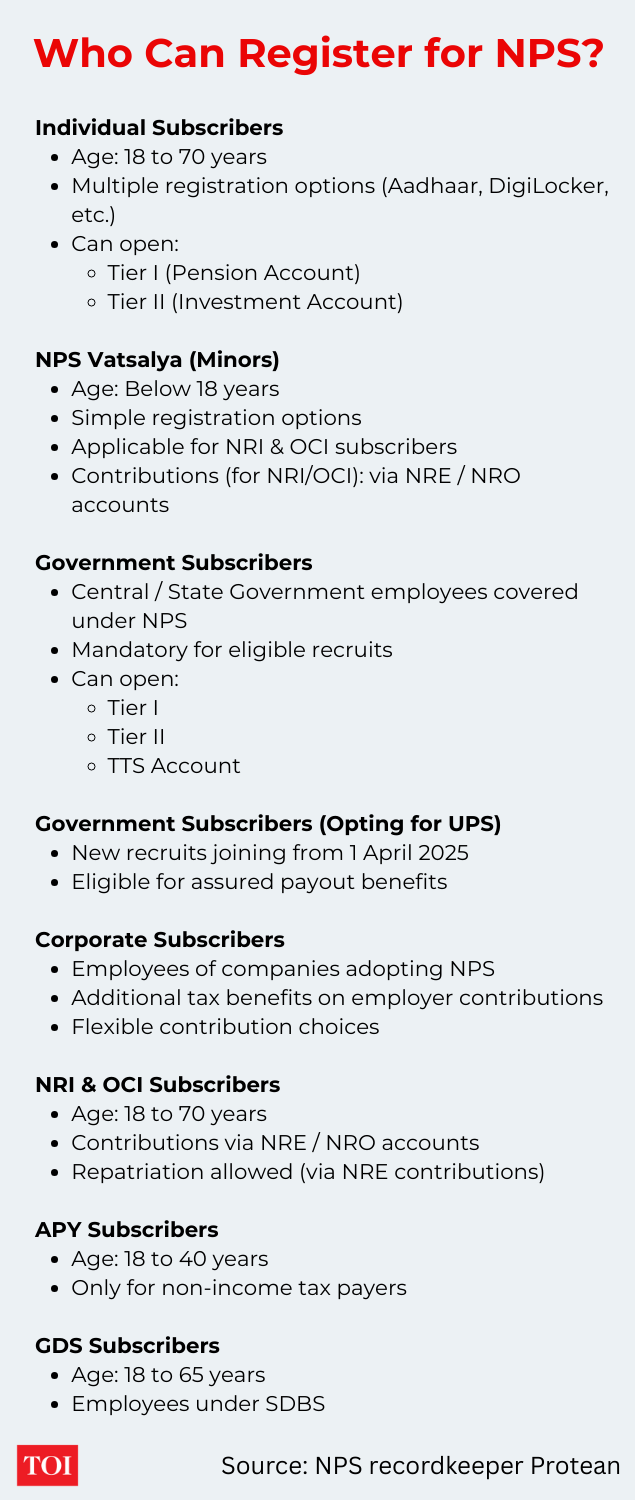
According to the NPS website, the scheme is defined as, “National Pension Scheme is a government-backed retirement savings plan where you invest during your working years to get income after retirement, with tax benefits and flexible investment choices.”Protean eGov Technologies Limited manages the core recordkeeping infrastructure of the National Pension System.NPS is open to:
- Government employees
- Private sector employees
- Corporate subscribers
- Self-employed professionals
- Individual citizens under the All Citizen Model
One of its biggest strengths is portability.
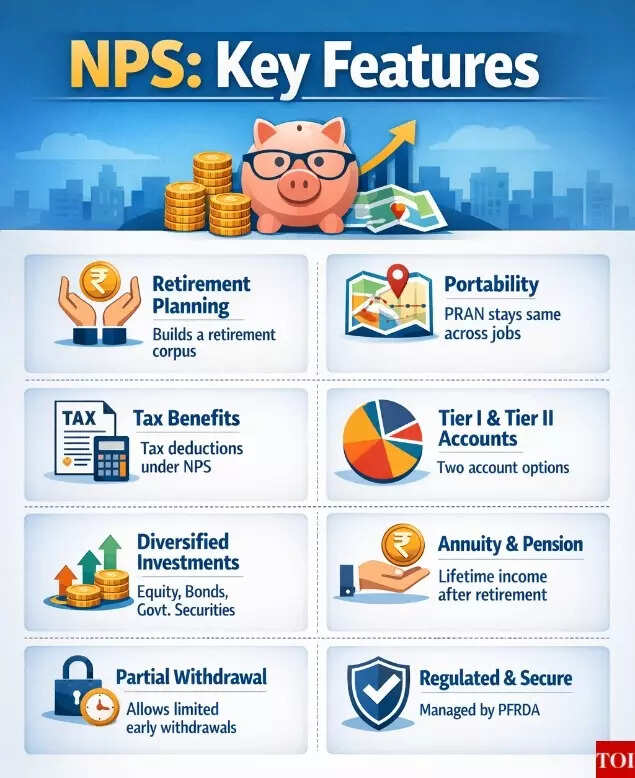
The account, identified by a Permanent Retirement Account Number (PRAN), remains the same even if a subscriber changes jobs, cities or employers.Experts say its disciplined structure makes it particularly effective for retirement planning.“Think of NPS as a mutual fund designed specifically for your retirement.
Its main purpose is to help you stay disciplined by keeping your funds invested until you reach age 60,” Archit Gupta, Founder and CEO of ClearTax told TOI.
Tier I and Tier II : Understanding the NPS account types
NPS has two types of accounts:Tier I Account (Primary pension account)This is the primary pension account, which has restricted withdrawal facilities.
The contributions made to this account are locked until the subscriber retires, with limited facilities for partial withdrawals.
This account is eligible for tax benefits.Tier II Account (Voluntary savings account)This account is more like a normal investment account, which allows the subscriber to withdraw money at any time.
However, this account is not eligible for tax benefits, unlike Tier I accounts for most subscribers.The Tier I account is the foundation of retirement planning in the NPS.
“Employer’s contribution to NPS Tier-I Account has been kept under preview of allowed deduction to promote NPS.
For those who prefer a steady monthly pension, NPS is still the best alternative as its effective return rate increases once we incorporate tax saving of 30-33% in the New tax Regime,” CA Ashish Niraj, Partner, A S N & Company, Chartered Accountants told TOI.Further talking about Tier-II investments, he added, “For Tier II 100% Equity can be allocated.
Therefore whether you are equity focused or debt inclined, if you consider the Tax Deduction aspect, there are chances that NPS will always have an edge if you prefer to have regular income.”
How NPS invests your money
NPS is a market-linked scheme.
Contributions are invested across multiple asset classes, namely:
- Equity (stocks)
- Corporate bonds
- Government securities
- Alternative investments such as REITs and InvITs
Subscribers can choose their allocation based on risk appetite or opt for automated lifecycle funds that adjust risk over time.This diversified structure balances growth and stability.Aarti Raote, Partner at Deloitte India, explained to TOI that NPS combines flexibility with retirement income security.
she said.
As a retiral benefit, NPS is a well-structured fund that provides a simple, voluntary, portable and flexible option for saving for retirement.
The scheme provides a benefit that is market linked and based on the investors risk appetite, one can invest in a debt, balanced or a high risk – high return equity option.
Aarti Raote, Partner at Deloitte India
CA Ashish Niraj, Partner, A S N & Company, Chartered Accountants also gave his view on if one should go for NPS for investment.
“As per my view if you have risk appetite then Market linked retirement options is better as it can offer greater returns also better liquidity.
Market linked funds allow you to withdraw up to 100%, annuity restrictions are there in NPS.
Whereas Market Linked Plans have mostly 5 year lock in, you need to stay invested in NPS till 60 years of age, except some cases where partial withdrawal is allowed. Also except small amounts of Rs 5 to 8 Lacs, you are required to choose annuity in NPS which is not the case in Market Linked schemes.
This feature of liquidity sometimes get preference over returns as money in hand gives you freedom,” he said.“For Investment also you can choose up to 100% equity option in Market linked whereas some debt component is compulsory in NPS,” he added.
NPS benefits
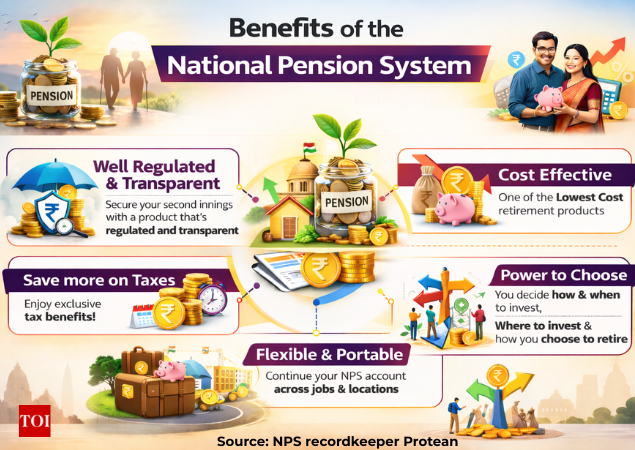
NPS offers several structural advantages:
Advantages:
- Long-term retirement focus
- Tax benefits (in certain conditions)
- Relatively safer option for investment
- Employer contribution advantage
- Regulated by government authority
- Diversified investment portfolio
- Lifetime pension component
Limitations:
- Limited liquidity before retirement
- Mandatory annuity component
- Less flexibility compared to mutual funds and few other investment options
“If you prioritize having easy access to your funds or the ability to change your investment strategy at any time, regular mutual funds may be more suitable.
The right choice depends on whether you prefer the structured, long-term nature of NPS or the flexibility offered by other market-linked options,” said ClearTax founder Archit Gupta.One of the most important benefits of NPS is the returns that it provides.
However, it does not provide a fixed rate of interest; instead, it provides market-linked returns, which may have a higher potential for growth in the long run compared to other retirement savings options but also involves a risk component.The investments made in NPS are diversified across equities, corporate bonds, and government securities, which enables the subscribers to share the benefits of the performance of the financial markets.
Major NPS reforms
One of the biggest recent changes allows non-government subscribers to withdraw up to 80 per cent of their retirement corpus as a lump sum at exit, compared to the earlier limit of 60 per cent.Under the amended rules:
- Up to 80% can be withdrawn as lump sum
- Minimum annuity requirement reduced to 20%, down from 40%
This applies to private sector employees, corporate subscribers and individual contributors.
The change increases liquidity and gives retirees greater control over their savings.
However, annuity remains mandatory to ensure pension income.
Offering an important clarification, Rohit Shah, Certified Financial Planner & Founder of Getting You Rich told TOI, “The recent revision now permits up to 80% lump-sum withdrawal at vesting—a significant jump from the earlier 60%. However, investors should note that the Income Tax Act currently exempts only 60% under Section 10(12A); clarity on the tax treatment of the additional 20% is still awaited, and this gap must be factored into exit planning.Experts say this annuity requirement plays an important protective role.
“Investors who require liquidity at retirement find this option extremely attractive as 60% of the balance is available at their disposal without taxation and the balance provides for retirement expenses – thus one can say that it is a balanced fund,” said Deloitte’s Aarti Raote.Full withdrawal allowed for smaller corpusThe rules also make it easier for subscribers with smaller retirement savings.
- If retirement corpus is up to Rs 8 lakh: full withdrawal is allowed.
- Between Rs 8 lakh and Rs 12 lakh: partial lump sum and staggered withdrawals is allowed.
- Above Rs 12 lakh: minimum 20% must go into annuity.
This benefits individuals with modest retirement savings by improving access to funds.Investment horizon extended to age 85Another major reform is the extension of the investment and exit age.
Subscribers can now remain invested in NPS until age 85, compared to earlier limits of 70 (entry) or 75 years (exit).This allows:
- Longer compounding period
- Higher potential retirement corpus
- Flexibility for individuals working beyond traditional retirement age
New investment flexibility through multiple schemes
The Multiple Scheme Framework (MSF) is a structural upgrade to NPS that gives subscribers greater control over how their retirement savings are invested.
Under MSF, investors are no longer restricted to a single pension fund manager or a limited set of predefined schemes.
Now, they can allocate their contributions across multiple schemes and even different pension fund managers within the same PRAN.
This allows subscribers to tailor their investments based on their risk appetite, financial goals, and market outlook, including the option of higher equity exposure, which is up to 100% for non-government subscribers.This enables:
- Greater diversification
- Schemes tailored to age and risk profile
- Potential for higher equity allocation
- More personalised retirement planning
Tax benefits: Old vs new tax regime
NPS offers tax benefits under both tax regimes, though the structure differs.Under the old tax regime:
- Up to Rs 1.5 lakh deduction under Section 80C
- Additional Rs 50,000 under Section 80CCD(1B)
- Employer contributions up to prescribed limits deductible
Under the new tax regime:
- Employer contribution up to 14% of salary deductible under Section 80CCD(2)
- No deduction for employee contribution
- The additional tax deduction of up to Rs 50,000 under Section 80CCD(1B) for self-contribution is also not available.
ClearTax CEO said employer contribution benefits remain a key advantage.

ClearTax’s founder also said, “When you reach 60, you can now take out up to 80% of your money as a lump sum.
However, under current tax laws, only 60% of the total fund is tax-free.
You must use the remaining 20% to buy an “annuity,” which provides you with a monthly pension.”Deloitte partner Aarti Raote also compared the benefits in terms of tax regimes saying, “Contribution to NPS is one avenue of tax saving that is available under the old tax regime as well as the new tax regime.
Under the old tax regime the employee contribution up to INR 1,50,000, Additional contribution of INR 50,000 and employer contribution up to 14% of the salary are allowable.
However under the Simplified tax regime deduction for employer contribution to NPS is allowable. Thus the benefit under the old regime is significantly higher.”
Loan access and withdrawal flexibility improved
In a first for the scheme, NPS withdrawals no longer necessarily require a permanent exit of funds.
According to Protean eGov Technologies Limited, subscribers can now use their NPS account as collateral to secure a loan from a regulated financial institution instead of withdrawing money outright.
The loan is limited to 25% of the subscriber’s own contributions.
This means that frequent NPS contributors, including salaried and private sector employees, can access funds for meeting urgent financial requirements such as medical expenses without withdrawing from their retirement savings.
Not just tax saving — but retirement discipline
For many investors, NPS offers something that other investments do not – forced discipline.
Unlike mutual funds, where money can be withdrawn easily, NPS ensures savings remain protected for retirement.Experts say this structure helps build meaningful long-term wealth.
Getting You Rich’s Shah’s, said, “One often-overlooked structural advantage is forced long-term discipline.
Unlike mutual funds or ULIPs, NPS locks investors into a retirement-only vehicle, eliminating the temptation to dip into retirement savings for short-term goals—a behavioural edge that compounds powerfully over 20–30 years.”Further explaining the advantages beyond tax he added, “though the Section 80CCD(2) benefit remains a compelling sweetener.
From FY 2025-26, employer contribution deduction has been raised to a uniform 14% of salary (Basic + DA) for all employees, private and government alike—a benefit no other retirement product matches.
Even without employer contribution, NPS offers a unique combination: multi-asset diversification (equity, corporate bonds, government securities, and alternative assets) within a single account, portability across jobs and cities, regulatory oversight* by PFRDA, and a *built-in annuity component that guarantees lifelong income—something voluntary market-linked products cannot structurally ensure.”Another way of validating the emerging significance of NPS is the growing subscriber base over the years.
The system’s subscriber base has expanded steadily over the past decade, more than tripling from 6.5 million in 2013–14 to over 21.3 million in 2025–26.
The growth has been increasingly driven by state government employees, corporate participation, and retail investors.
The bigger picture
India’s workforce is increasingly responsible for its own retirement security, especially in the private sector.Traditional pension guarantees have largely disappeared outside government employment.
The increase in life expectancy and inflation rates has made retirement planning more important than ever before.The NPS reforms reflect this shift.By allowing greater withdrawals, extending investment duration, and improving flexibility, the system is adapting to modern workforce realities.“NPS is no longer just a tax-saving tool.
It has evolved into a genuinely flexible, diversified, and disciplined retirement solution.
The cost-benefit equation has changed—but on most counts, in NPS’s favour, not against it,” said Rohit Shah.Thus, while it may not replace flexible investments like mutual funds, NPS remains one of India’s most comprehensive retirement planning instruments