AI reshapes IT talent’s pyramid model

 “The shift is from coding depth to problem framing,” said Gilroy Mathew, COO of UST.
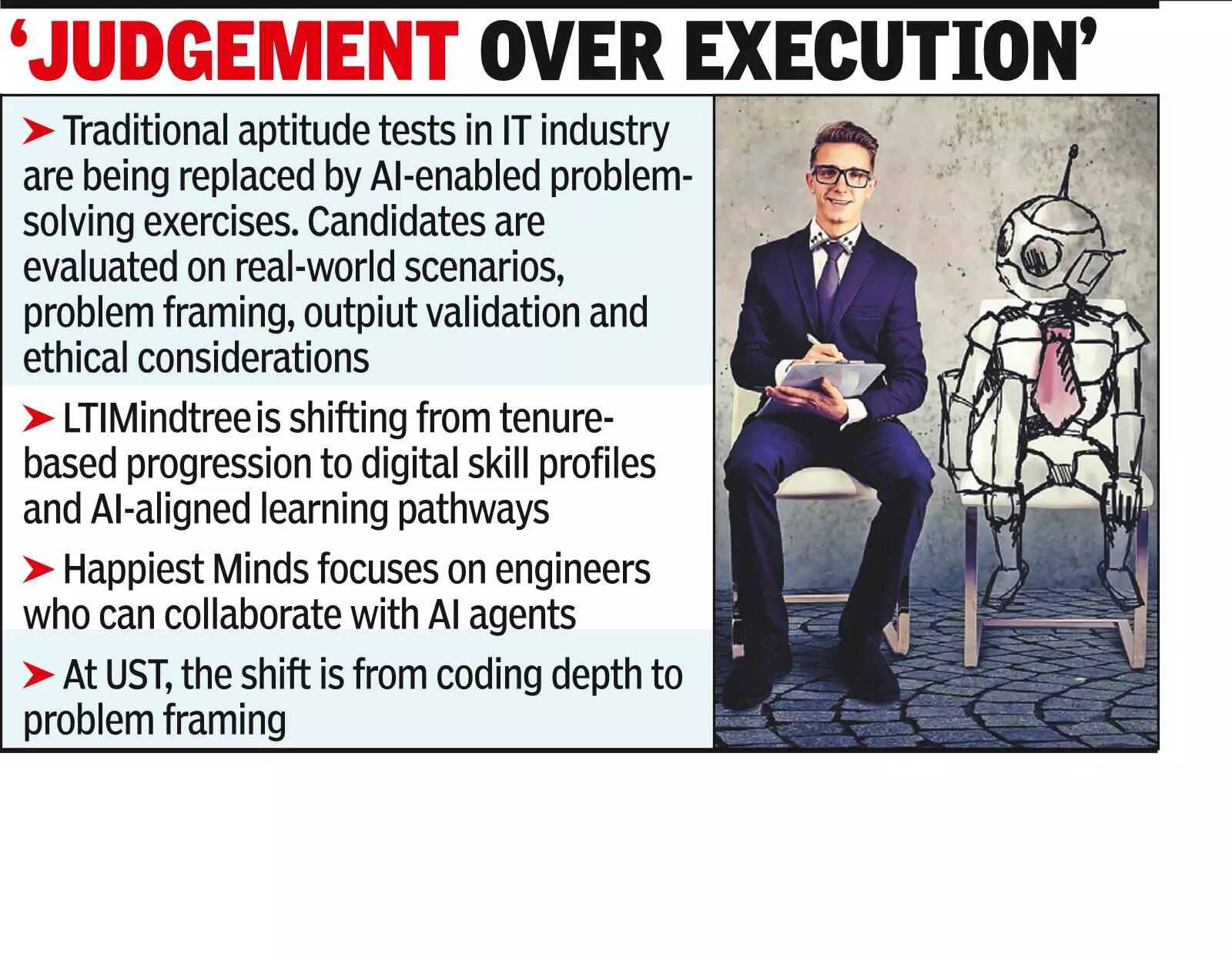
Instead of testing whether candidates can write a Java function, firms now ask whether they can define business problems, break them into AI-executable steps, and validate outputs for bias, risk and completeness.
Access to AI tools is narrowing the gap between freshers and mid-level engineers.
A well-trained entry-level hire is expected to become productive faster than before.
.
LTIMindtree describes the emerging structure as a “diamond” rather than a pyramid.
At the base is a smaller layer of AI-fluent engineers, supported by automation and AI agents handling routine execution.
In the middle, architects and managers are evolving into orchestrators-designing AI-first workflows, integrating systems and aligning delivery with business goals.
“It’s not about fewer people; it’s about fewer people doing low-judgement work,” said Gururaj Deshpande, chief delivery officer at LTIMindtree, arguing that AI-led productivity gains will help clear larger project backlogs rather than simply reduce headcount.
One clear shift is the shrinking space for purely supervisory managers.
In an AI-led environment, managers are expected to redesign processes around automation, understand agent-based workflows, ensure AI governance and tie execution to business KPIs. Hiring models are changing in parallel.
At UST, screening moved from “employability” to “adaptability”.
Candidates are given real-world business scenarios and evaluated on how they frame problems, use AI tools, validate outputs and factor in ethical considerations.