Boost for Nvidia! Trump allows tech giant to ship H200 chips to China; but will Beijing look to reduce dependence?
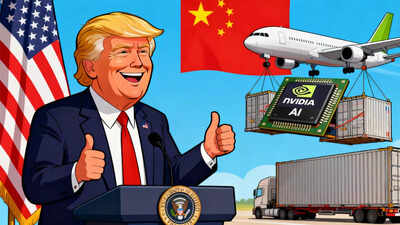
“NVIDIA’s US Customers are already moving forward with their incredible, highly advanced Blackwell chips, and soon, Rubin, neither of which are part of this deal.”The announcement lacked specifics about H200 chip export quantities or conditions, only stating that exports would proceed “under conditions that allow for continued strong National Security.”Government officials view this decision as a balanced approach between restricting Nvidia’s latest Blackwell technology exports to China and maintaining some level of US chip presence to counter Huawei’s growing influence in China’s AI chip market, according to an informed source.“Offering H200 to approved commercial customers, vetted by the Department of Commerce, strikes a thoughtful balance that is great for America,” Nvidia stated.A White House representative explained that the 25% fee would be levied as an import duty when the chips travel from Taiwan to the United States for security assessment before their onward journey to China.
Security concerns
Security experts in Washington express concerns that providing advanced AI chips to China could enhance their military capabilities, which initially prompted the Biden administration to implement export restrictions.“It’s a terrible mistake to trade off national security for advantages in trade,” stated Eric Hirschhorn, a former Commerce Department official during Obama’s presidency.
“It cuts against the consistent policies of Democratic and Republican administrations alike not to assist China’s military modernisation.”The Institute for Progress (IFP), a non-partisan research organisation, released findings indicating the H200 would deliver nearly six times the processing power of the H20, currently China’s legally permitted most advanced AI semiconductor, following Trump’s administration’s reversal of its brief export prohibition this year.The upgraded Blackwell chip utilised by American AI companies delivers 1.5 times enhanced training speed compared to H200 chips, according to IFP, whilst offering five times faster inferencing capabilities.
Nvidia’s research indicates Blackwell chips perform certain tasks ten times quicker than H200 chips.Several Democratic senators criticised Trump’s decision as a “colossal economic and national security failure”, suggesting it would benefit Chinese industry and military advancement.House China Select Committee Chairman, Republican Representative John Moolenaar, expressed concerns to Reuters about China’s potential use of these chips for military and surveillance purposes.
China looks to diversify
China’s growing determination to reduce dependence on Nvidia’s chips coincides with this approval.
In July, Chinese cybersecurity regulators raised concerns about possible security vulnerabilities in H20 chips, which Nvidia has contested.Beijing has advised Chinese technology firms against purchasing modified Nvidia chips, including H20, RTX 6000D and L20 models, according to two sources.The H200 policy revision occurred simultaneously with Trump’s Justice Department revealing a China-connected chip smuggling operation that handled about $160 million worth of restricted Nvidia H100 and H200 chips during late 2024 and early 2025.Former US State Department technology expert Chris McGuire suggests Chinese organisations would likely continue purchasing H200s, given their superior performance compared to domestic alternatives.China’s domestic AI chip sector includes prominent manufacturer Huawei Technologies, which released a three-year strategic plan in September, alongside smaller firms like Cambricon and Moore Threads.