Economists expect RBI to cut rates as inflation eases

 A cut helps borrowers but strains bank margins as lenders struggle to match deposits with credit demand.
Savers may also shift to markets as nominal returns fall.“We expect RBI to deliver a 25bps repo rate cut in the Dec policy.
Based on our forecast of FY27 growth, inflation and real rates, a simple Taylor Rule formula indicates that the terminal repo rate should fall to 5.25%, from 5.5% currently,” said Kaushik Das of Deutsche Bank.
Broadly, the Taylor rule guides interest rates by comparing actual inflation and output with targets.
Rates rise when both run hot and fall when they undershoot.“In FY27, if CPI inflation averages 4.2-4.3% (from a likely 2% average in FY26), then real rates will remain positive by about 100bps, assuming a terminal repo rate of 5.25%, which is sufficient to maintain macro financial stability, in our view,” added Das.
The latest inflation numbers in India show a sharp decline, with consumer price index inflation dropping to a record low of 0.25% year-on-year in Oct 2025, provisional data from govt showed.
This is the lowest inflation in the current CPI series since 2013.
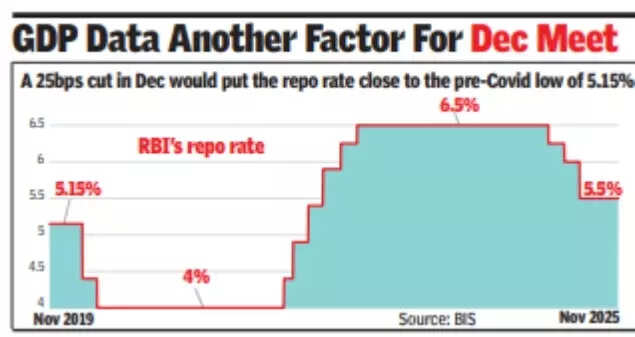
Wholesale prices are also in deflation thanks to the one-time GST cut impact.The repo rate, which influences more than half of all loans, is 5.5% after 100bps of cuts since Feb 2025: 25bps in Feb, 25bps in April, 50bps in June.
Before the Covid trough of 4%, the non-Covid low was 5.15% in Oct 2019.
A Dec cut to 5.25% would put policy close to that floor.Domestic growth remains firm, but external risks including trade tension and US restrictions could keep the MPC cautious even if it eases in Dec.
Analysts frame the decision as calibrating the pace of easing rather than choosing between easing and tightening, part of a three-pronged cycle of adjustments in rates, liquidity and regulation.
“RBI’s rate move in Dec will be a close call, as Q2 GDP data in late Nov will show growth at a firm 7%+ while Oct inflation slipped to a series low. To make a case for rate reductions despite strong growth numbers, RBI MPC will likely highlight risks to the forward-looking growth trajectory, with prevailing low inflation providing them with the necessary room to reduce rates,” said Radhika Rao of DBS.Crisil also expects a cut, arguing that benign inflation should allow support for growth amid US tariff risks.
Morgan Stanley and Goldman Sachs share that view.
Globally, several major central banks have begun or continued easing because inflation is subdued and growth is cooling, giving the RBI a supportive backdrop.