Trade deficit widens to $25 billion as imports rise 9%

 Exports to the US, where Indian goods face a 50% tariff, were estimated at $6.9 billion in Dec 2025, compared with $7 billion a year ago, latest numbers released by the commerce department showed.
Imports were 7.6% higher at $4 billion, driven by a 40-50% jump in oil shipments.“We have been holding well.
We are in positive territory…Going forward, we hope that we will be in positive territory,” commerce secretary Rajesh Agrawal told reporters.
He said India could end the year with over $850 billion exports with services, for the first time, likely to cross the $400 billion mark.
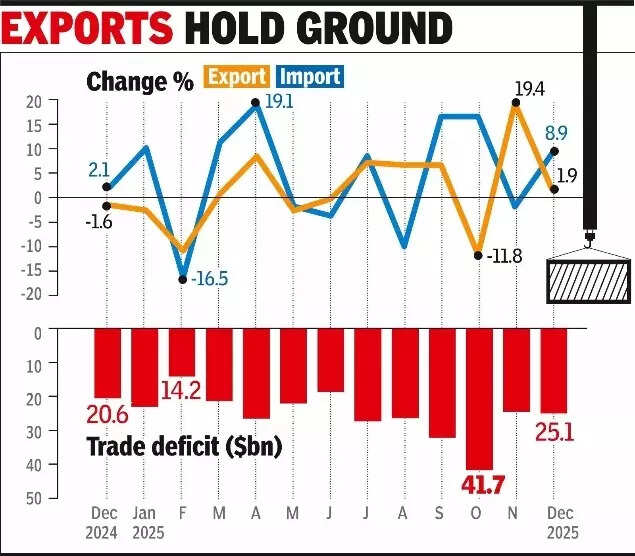
During Dec, services exports were estimated to have fallen 4.2% to $37 billion, while imports were 2% higher at $17.4 billion.On the goods side, exports of electronics, gems and jewellery, engineering and apparel saw an increase, while oil products declined on lower prices.“The Dec 2025 export performance showing a modest growth of 2.9% for the RMG sector reflects both the resilience and adaptability of our industry in a challenging global environment.
While demand in key international markets such as the US has been uneven due to inflationary pressures and geopolitical uncertainties, Indian apparel exporters have managed to hold ground through product diversification, improved compliance, and a stronger focus on value-added segments,” said AEPC chairman A Sakthivel.EEPC India chairman Pankaj Chadha said market diversification was among the key reasons driving growth, but added: “In the wake of persistent challenges, primarily stemming from Trump tariff and geopolitical tensions, there is greater need for govt support.”“Diversification is particularly critical at a time when global trade routes are being reshaped due to geo-political conflicts, sanctions, shipping disruptions and strategic realignments,” added Fieo president SC Ralhan.