US tariffs on India cut to 18%; $30 trillion market access – India-US trade deal explained in 10 points
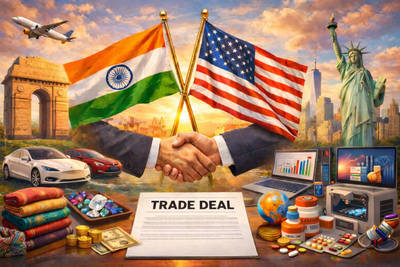
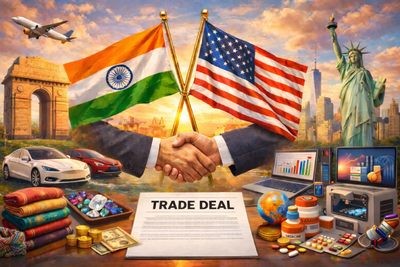
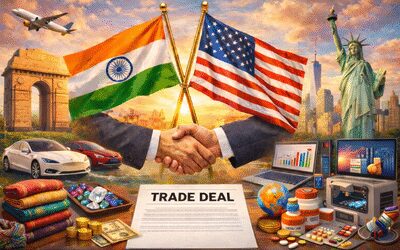
India and the United States released a joint statement on Saturday, announcing the framework for an interim trade agreement.
Under the newly announced trade pact, tariffs on Indian goods will drop from 50% to 18%. “The US and India are pleased to announce that they have reached a framework for an Interim Agreement regarding reciprocal and mutually beneficial trade,” the joint statement said.Both nations have held repeated trade negotiations over the past months, as talks stalled after the US imposed 50% tariffs on Indian imports.
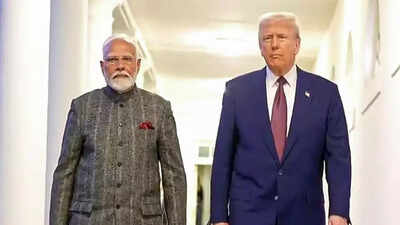
Of this, 25% duties were introduced in August, with the US alleging that India was supporting Russia’s war efforts against Ukraine through its buys.The framework also reaffirms the commitment of both countries to the broader US-India Bilateral Trade Agreement negotiations, launched by PM Modi and US President Donald Trump in February 2025, following months of trade tensions over India’s buy of Russian oil.Also read | Trump signs executive order lifting 25% tariff penalty on India
Here are the top 10 key takeaways from the interim trade deal :
- Tariffs on Indian goods: The United States will cut import duties on Indian products to 18%, covering textiles and apparel, leather and footwear, plastic and rubber products, organic chemicals, home decor, artisanal products, and select machinery.
Furthermore, after the successful conclusion of the interim trade agreement, the US will remove tariffs on several Indian goods, including generic pharmaceuticals, gems and diamonds, and aircraft parts.
- Tariffs on US goods: India will eliminate or reduce tariffs on all US industrial goods and a wide range of food and agricultural products, such as dried distillers’ grains, red sorghum for animal feed, tree nuts, fresh and processed fruit, soybean oil, wine and spirits, among others.
- Protection for India’s agriculture sector: Union commerce and industry minister Piyush Goyal reassured that the agreement safeguards Indian farmers’ interests and supports rural livelihoods by fully protecting sensitive agricultural and dairy products, including maize, wheat, rice, soya, poultry, milk, cheese, ethanol (fuel), tobacco, certain vegetables, and meat.
- India’s $500 billion buy: Over the next five years, India plans to buy $500 billion of US energy products, aircraft and parts, precious metals, technology products, and coking coal, significantly increasing bilateral trade and market opportunities.
- Russian oil trade: White House has claimed that India will end Russian oil imports, buy US energy products, and expand defence cooperation with the United States over the next 10 years.
India is yet to respond to this claim and has maintained that ensuring energy security remains the supreme priority.
“Diversifying our energy sourcing in keeping with objective market conditions and evolving international dynamics is at the core of our strategy to ensure this,” MEA spokesperson Randhir Jaiswal said in a statement.
- Vast market for Indians: Piyush Goyal said that the India-US trade pact will open a $30 trillion market for Indian exporters, especially MSMEs, farmers and fishermen, creating lakhs of new jobs for women and youth.
- Preferential market access: India and US will commit to grant each other preferential market access in key sectors on an ongoing basis.
The US will remove tariffs on certain Indian aircraft and aircraft parts previously imposed for national security.
New Delhi will also receive a preferential tariff rate quota on automotive parts and get negotiated outcomes for generic pharmaceuticals and ingredients.
- Boost to digital and technology trade: Both nations will tackle barriers to digital trade, increase trade in technology products including GPUs and data centre goods, and expand joint technology cooperation.
- Market access and non-tariff barrier resolution: Both nations will work to remove non-tariff barriers affecting bilateral trade.
“India agrees to address long-standing barriers to the trade in US” medical devices, ICT goods, and food and agricultural products, eliminate restrictive import licensing, and review standards within six months to ensure smoother market access for American exports.
- Trade expansion: The framework sets the stage for finalising the Interim Agreement and advancing the full Bilateral Trade Agreement, with provisions to reduce tariffs further.
Also read | PM Modi hails India-US trade deal, thanks Trump