Small Business Insurance Quotes Online: A 2026 Guide to Getting Covered Fast (Without Overpaying)
You started your business to build something — not to spend your Tuesday afternoon on hold with an insurance agent. Yet one uninsured claim (a client who trips in your studio, a laptop stolen from your car, a lawsuit over a missed deadline) can wipe out months of profit in a single event.
The good news: getting small business insurance quotes online today takes minutes, not weeks. The harder part is knowing which quotes actually matter, what coverage you genuinely need, and how to compare offers that all look slightly different on paper.
This guide walks through exactly that — grounded in real 2026 pricing data, not guesswork.
Why “Getting a Quote” Feels Confusing in 2026
Search “small business insurance quotes online,” and you’ll land on comparison sites, direct carriers, and brokers — all promising the fastest, cheapest option. Three things make this genuinely confusing right now:
- Pricing has widened. Depending on industry and risk level, monthly general liability premiums for small operations can run anywhere from under $30 to several hundred dollars, so a single “average price” you see quoted online rarely applies to your specific business.
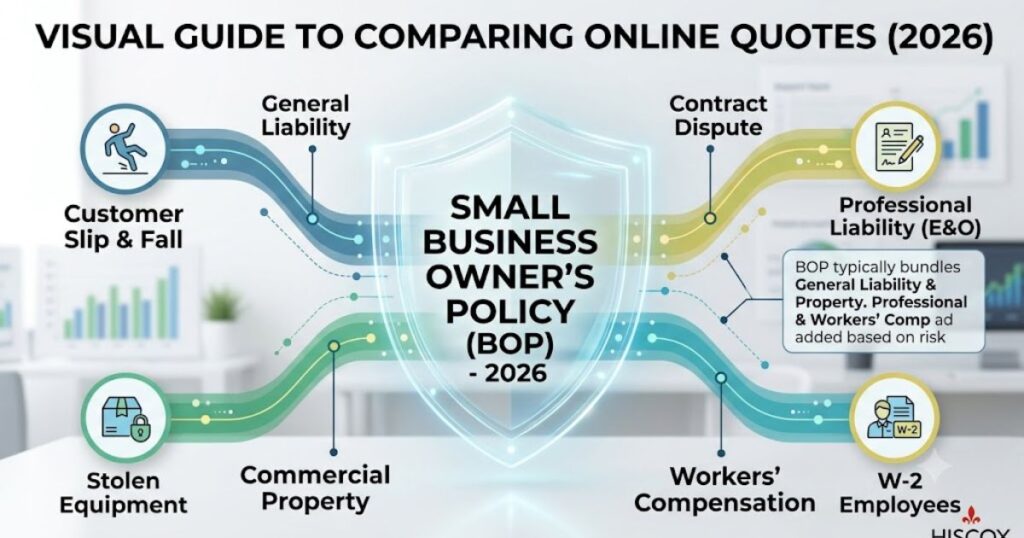
- Bundled policies are now the norm. Most small businesses no longer buy one policy — they combine general liability, property, and business interruption coverage into a Business Owner’s Policy (BOP), which changes how quotes are priced and compared.
- Digital-first carriers have changed expectations. Insurers built for fast online underwriting (Hiscox among them) can now issue quotes and bind coverage same-day for many professional service businesses, which older insurers still can’t match.
What Actually Drives Your Quote Price
Before comparing quotes, it helps to know what’s under the hood. Insurers price small business policies using a handful of core factors:
1. Industry and Risk Category
A bookkeeper and a general contractor will never see the same quote, even at identical revenue. Office-based consultants and freelancers sit in the lowest risk tiers; physical, client-facing, or high-liability trades sit higher.
2. Number of Employees
More people generally means more payroll, more client interactions, and more exposure — which is why solo consultants often pay well under $100 a month while a 20-person team can see premiums climb into the hundreds.
3. Revenue and Business Size
Higher revenue signals larger potential claims to underwriters, so it factors into pricing even when your actual operations haven’t changed much.
4. Coverage Limits and Deductible
A $1M/$2M general liability policy (the common small business standard) costs more than a policy with lower limits — but skimping on limits to save $10/month is rarely worth the exposure.
5. Claims History
A clean claims record, even over just a year or two, tends to earn meaningfully better renewal pricing.
What Small Businesses Actually Pay in 2026
Here’s a realistic snapshot based on current market data, not marketing copy:
| Policy Type | Typical Monthly Range | Best For |
|---|---|---|
| General Liability | $30 – $150 | Nearly every business — customer injury, property damage |
| Business Owner’s Policy (BOP) | $60 – $220 | Businesses with a physical location or equipment |
| Professional Liability (E&O) | $40 – $150 | Consultants, freelancers, advisors, agencies |
| Workers’ Compensation | $45 – $100 per employee | Any business with W-2 employees (required in most states) |
| Cyber Liability | $100 – $145 | Businesses handling client data, payments, or online tools |
These are national ranges — your actual quote will land somewhere on this spectrum depending on the factors above. If a quote comes in dramatically below these ranges, it’s worth double-checking the coverage limits before assuming you found a bargain.
How to Get a Quote Online in 15 Minutes (Without Getting It Wrong)
Step 1: Know Your Business Classification Before You Start
Insurers price by industry class code. If you’re a “marketing consultant” but the quote form defaults you to “advertising agency,” your price — and your coverage gaps — can shift significantly. Have your actual business activities written down before you start.
Step 2: Separate “Required” from “Recommended”
- Often legally or contractually required: Workers’ comp (once you have employees), commercial auto (if you drive for business), professional liability (often required by client contracts for consultants).
- Strongly recommended but not always mandatory: General liability, cyber liability, a BOP if you lease space.
Step 3: Get More Than One Quote — But Only From Reputable Carriers
This is where a lot of business owners either overpay or under-insure. Comparison sites can be useful for a first-pass sense of pricing. Still, for the actual policy, it’s worth going directly to carriers known for serving small businesses and freelancers specifically. Hiscox, for example, built its small business line specifically around solo consultants, freelancers, and LLC owners — its online application is short, its professional liability and general liability quotes are usually available immediately, and coverage can often be bound the same day without a phone call.
Step 4: Check the Fine Print on These Three Things
- Occurrence vs. claims-made policy — this affects whether you’re covered for incidents reported after the policy ends.
- Aggregate limit — the total the policy pays out per year, not just per claim.
- Industry exclusions — some policies exclude specific services (e.g., certain financial or medical advice) unless added as an endorsement.
A Real-World Example
A freelance graphic designer in Texas, working solo with no employees, typically qualifies for a professional liability policy in the $25–$45/month range, since the risk profile (no physical location, no employees, no heavy equipment) is low. Add general liability for client meetings or trade shows, and the combined cost often still stays under $80/month — a small trade-off against the risk of a single client dispute over a missed deliverable turning into a costly legal claim.
Compare that to a small landscaping LLC with three employees: workers’ comp alone could run $150–$300/month for the team, plus general liability for equipment and property damage — a much higher but also much more necessary spend given the physical risk involved.
Common Mistakes to Avoid
- Insuring based on price alone. The cheapest quote often has the lowest limits or the most exclusions.
- Skipping professional liability as a “creative” or “consultant.” Client disputes over deliverables, advice, or missed deadlines are common — and general liability doesn’t cover them.
- Assuming your homeowner’s or personal auto policy covers business use. It rarely does.
- Waiting until after a client asks for a Certificate of Insurance. Many contracts require proof of coverage before work starts — get quoted before you need it, not after.
FAQ
How fast can I actually get small business insurance online? For most freelancers and consultants, a quote takes 5–10 minutes, and coverage can often be issued the same day through digital-first carriers like Hiscox — no medical exam, no in-person meeting required for most policy types.
Do I need business insurance if I’m a solo freelancer with no employees? Yes, in most cases. Client contracts frequently require professional liability coverage, and even a solo operation can face a lawsuit over advice, errors, or an in-person meeting gone wrong.
What’s the difference between general liability and professional liability? General liability covers third-party bodily injury and property damage. Professional liability (errors & omissions) covers claims that your work, advice, or service caused a client financial harm — the more relevant coverage for consultants, agencies, and service providers.
Can I bundle policies to save money? Often, yes. A Business Owner’s Policy combines general liability and property coverage at a discount compared to buying them separately, though it’s most useful for businesses with a physical location or equipment.
Will getting multiple quotes hurt anything? No — unlike personal credit inquiries, shopping multiple business insurance quotes doesn’t affect your credit score or business standing. It’s genuinely worth comparing two or three before choosing.
Get Your Quote
The fastest way to know your real number is to get an actual quote — national averages only get you so far. If you’re a freelancer, consultant, or small LLC owner, Hiscox’s online quote tool is built specifically for businesses like yours: a short application, transparent pricing, and same-day coverage in most cases.
Get your free Hiscox small business insurance quote →

He is a dedicated Business Insurance Specialist and the founder of BusinessInsuranceTalk.com. With years of experience in risk management, he simplifies complex policies like General Liability and Professional Indemnity to help US small business owners secure affordable, high-quality coverage.